

Diving Into Leadership
CACC Launches SCUBA Unit at Summer Encampment
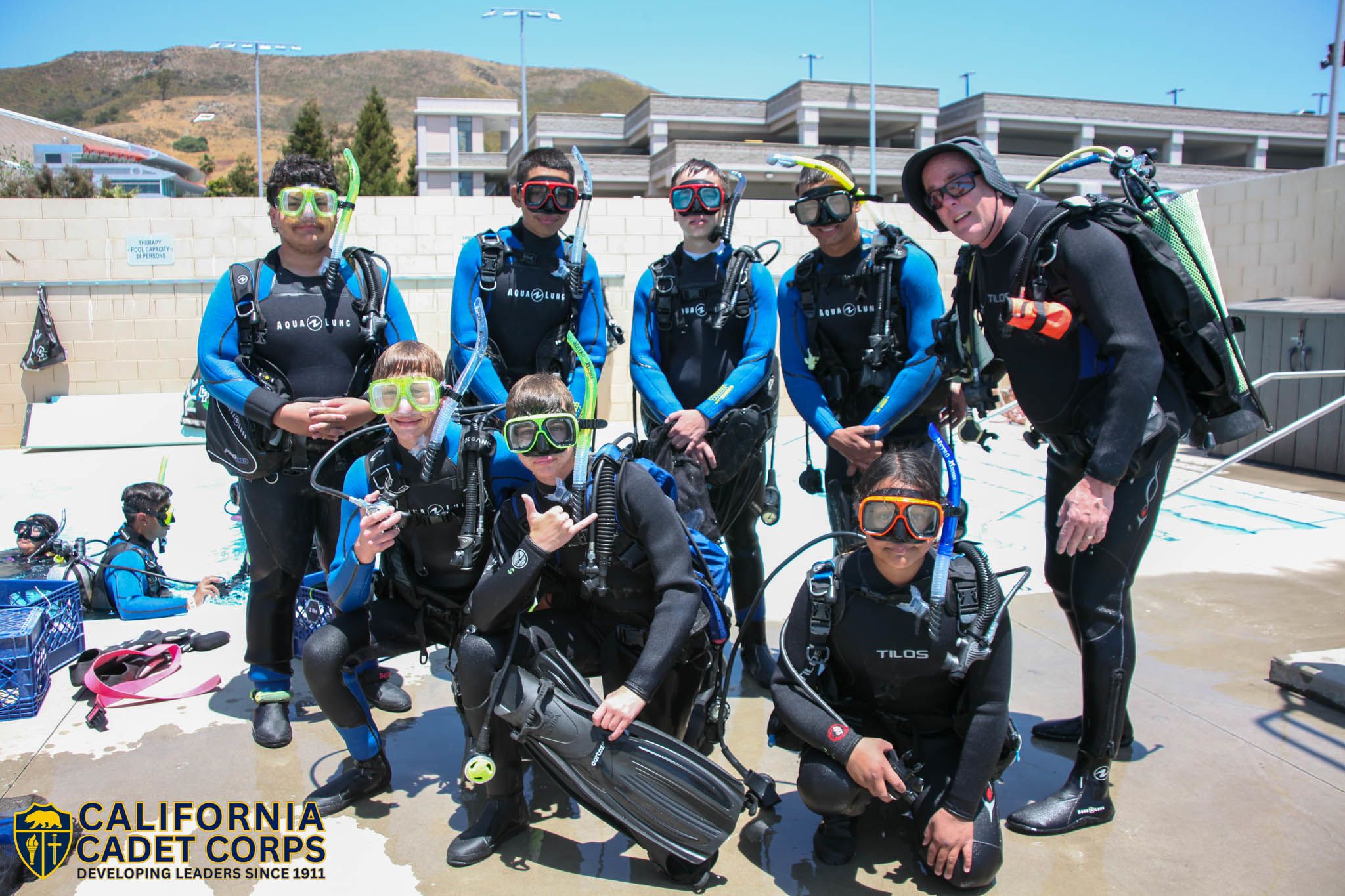

by Capt. James Colbert
California Cadet Corps Public Affairs
June 24, 2025
SAN LUIS OBISPO, Calif. -- One of the most exciting additions to the specialized training offerings at this year’s California Cadet Corps Summer Encampment is the SCUBA unit, an innovative program that submerges cadets into a whole new kind of challenge.
Almost as soon as the SCUBA course was announced, the roster filled to its maximum of 12 cadets. The overwhelming demand was unsurprising. The SCUBA unit offers more than just an underwater adventure; it aims to foster leadership, technical competence and environmental awareness.
Cadets who complete the course earn their PADI Open Water Diver certification—an achievement that holds significance in both educational and career fields. PADI stands for the Professional Association of Diving Instructors, the leading organization for recreational diver training. To be eligible to participate, cadets must be at least 15 years old and must have passed a swim test that includes a continuous 200-meter swim and treading water without assistance for 10 minutes.

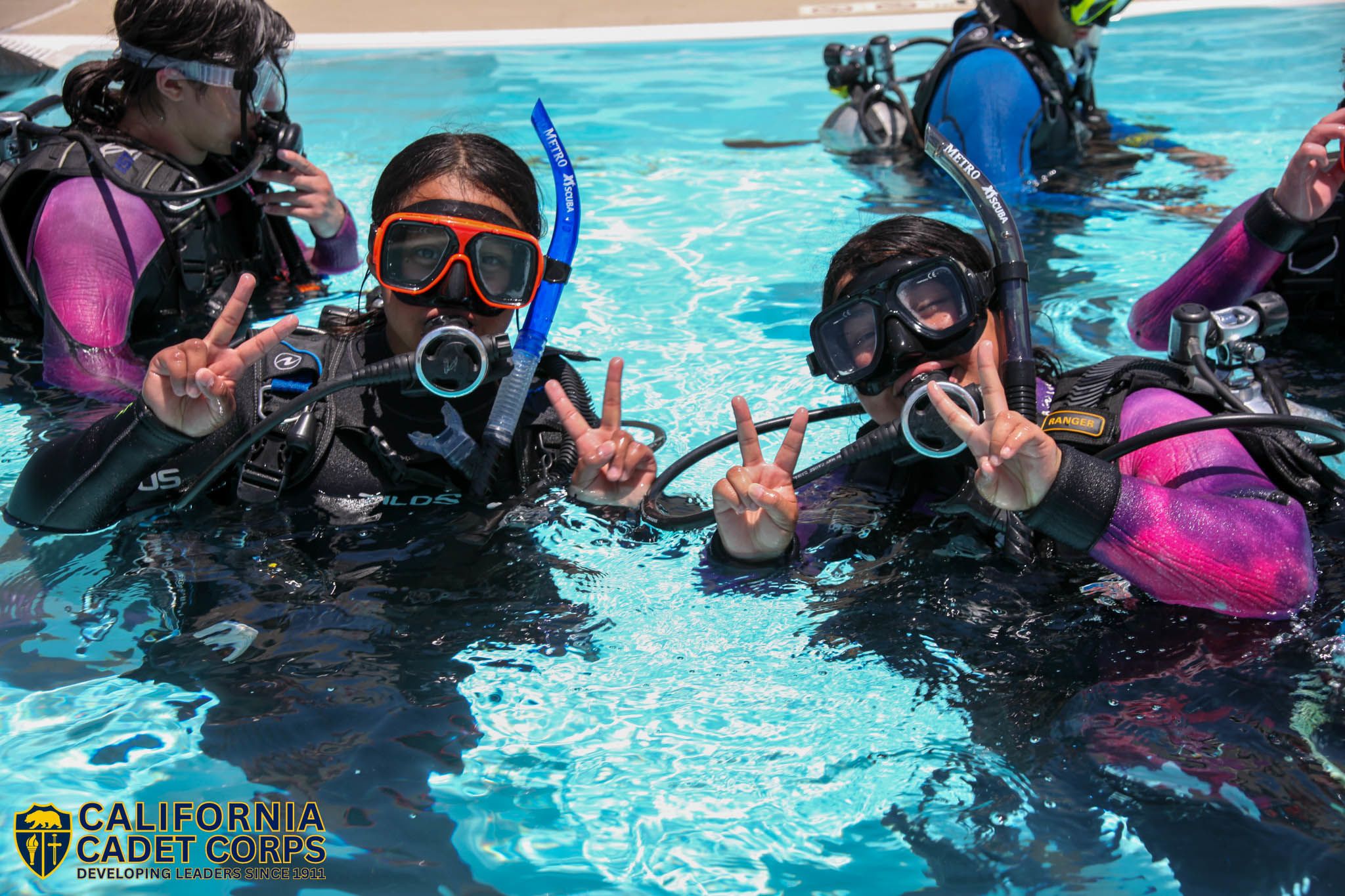
Cadets with the California Cadet Corps’ first-ever SCUBA unit test their equipment and practice breathing techniques during initial pool orientation at California Polytechnic State University, San Luis Obispo, Calif. Before heading into deeper water, cadets gain confidence and comfort in a controlled environment. (Photo By CACC 1st. Lt. Jennifer Brofer)
Cadets with the California Cadet Corps’ first-ever SCUBA unit test their equipment and practice breathing techniques during initial pool orientation at California Polytechnic State University, San Luis Obispo, Calif. Before heading into deeper water, cadets gain confidence and comfort in a controlled environment. (Photo By CACC 1st. Lt. Jennifer Brofer)
The SCUBA unit is the brainchild of CACC Capt. Ryan Smith, who serves as the unit’s officer in charge, and CACC Chief Warrant Officer 3 Eric Pendery, the program’s lead instructor. Together, they created the curriculum, secured funding, gained approval to proceed and recruited CACC Lt. Col. Michael “Mike” Mizner to assist with instruction.
Mizner contributes his extensive technical diving expertise to the program. In addition to 14 years of SCUBA instructor experience, he is a certified technical diving instructor, capable of teaching advanced techniques beyond recreational diving, including deep-sea diving, decompression procedures and rebreather systems.
“We also have two cadet medics with us and three other adults who are SCUBA-certified,” Mizner said. “They're Cadet Corps members who are trained in life-saving techniques, and we also have medical equipment, including oxygen, on site. We're ready for any emergency that could potentially happen.”

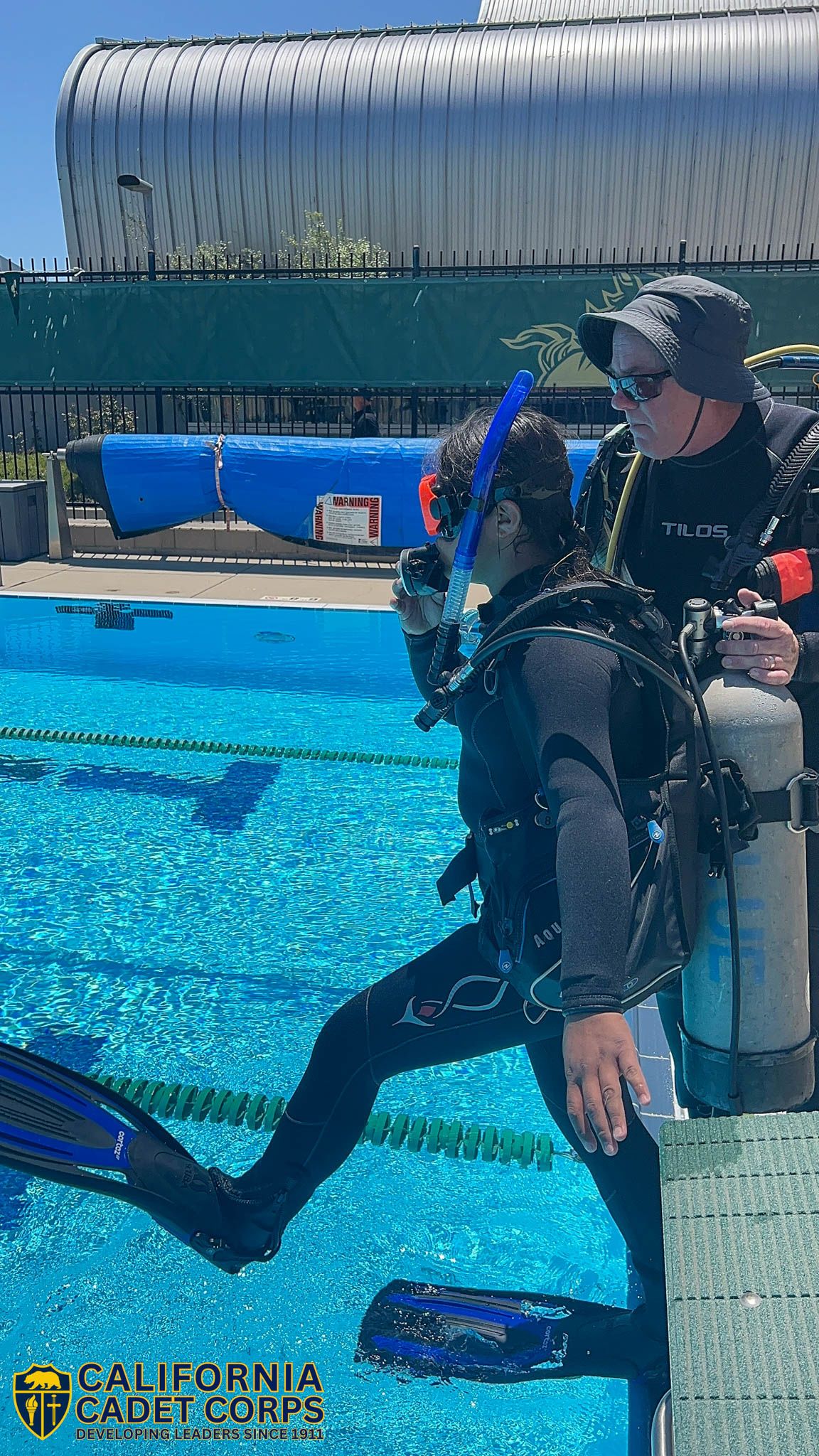
A cadet with the California Cadet Corps’ SCUBA unit steps off the edge of the pool during initial gear familiarization training at California Polytechnic State University, San Luis Obispo, Calif. The controlled pool environment allows cadets to build confidence and practice proper entry techniques before advancing to open water dives. (Photo by CACC 1st Lt. Jennifer Brofer)
A cadet with the California Cadet Corps’ SCUBA unit steps off the edge of the pool during initial gear familiarization training at California Polytechnic State University, San Luis Obispo, Calif. The controlled pool environment allows cadets to build confidence and practice proper entry techniques before advancing to open water dives. (Photo by CACC 1st Lt. Jennifer Brofer)
The six-day course combines classroom instruction with pool and open-water dive sessions. Cadets begin their training at the Olympic-size swimming pool at California Polytechnic State University, where they learn the fundamentals, including mask removal and replacement, regulator recovery, buoyancy control, equipment handling and finning techniques.
“We're going to do all the basic skills here at the swimming pool,” Mizner said. “Once they master that, we're going to do dives in the ocean at Morro Bay. The first few dives will be in areas with a sandy bottom, and that's where we'll focus on further developing basic skills. Our final dive will be underneath the pier at the Morro Bay Coast Guard station, which is brimming with aquatic life.”
Dive sites were selected with guidance from Depth Perception Diving Services, a respected San Luis Obispo outfitter with nearly four decades of experience.


Cadets with the California Cadet Corps’ first-ever SCUBA unit prepare to enter the open water for their initial ocean dive in Morro Bay, Calif. (Photo courtesy of U.S. Army Capt. Chloe Ahle)
Cadets with the California Cadet Corps’ first-ever SCUBA unit prepare to enter the open water for their initial ocean dive in Morro Bay, Calif. (Photo courtesy of U.S. Army Capt. Chloe Ahle)
“What makes the SCUBA unit significant is that it's something completely different than the traditionally taught skills such as land navigation, mountaineering and medical care,” added Mizner. “It's expensive, but we've had some great donors like the LEAD Foundation that have helped us reduce the cost. The cadets are getting a great certification when they walk out of here. So, it's an awesome opportunity for them.”
For Mizner, SCUBA diving is more than a skill—it’s a passion. “It's an experience that you never can imagine until you do it,” he said. “The most undiscovered part of the world is in the ocean. We know more about the moon than we know about the ocean. So, it's pretty cool to be part of that.”
Cadet Cpl. Amy Figueroa, 15th Brigade, from Sacramento, is looking forward to “doing a deep dive in the ocean to see all sea life.” The 15-year-old rising sophomore, who hopes to one day become a marine biologist, cannot wait to share her adventures with her family. “I want to tell them about what's under the water and share everything I learn.”
As the California Cadet Corps continues to expand its offerings, the SCUBA unit is already making waves—challenging cadets to explore new depths of leadership, confidence and personal growth.

 Built with Shorthand